

"Baba I tried Kamala bhog and failed again!" I called my father after the 2nd attempt at making one of my favorite Bengali desserts.
Baba asked probably knowing my answer, "what did you do?"
"I just made it like Roshogolla and I failed. While boiling the cheese balls, it just scattered."
Jump to:
- Biyebari, Haluikor Bamun, Vien, Mishti, etc before going further with Kamala Bhog!
- Difference between Roshogolla, Rajbhog, and Kamala Bhog!
- ....and then Sodesh, Bonde, Darbesh, Doi, Nimki & Khirmohon!
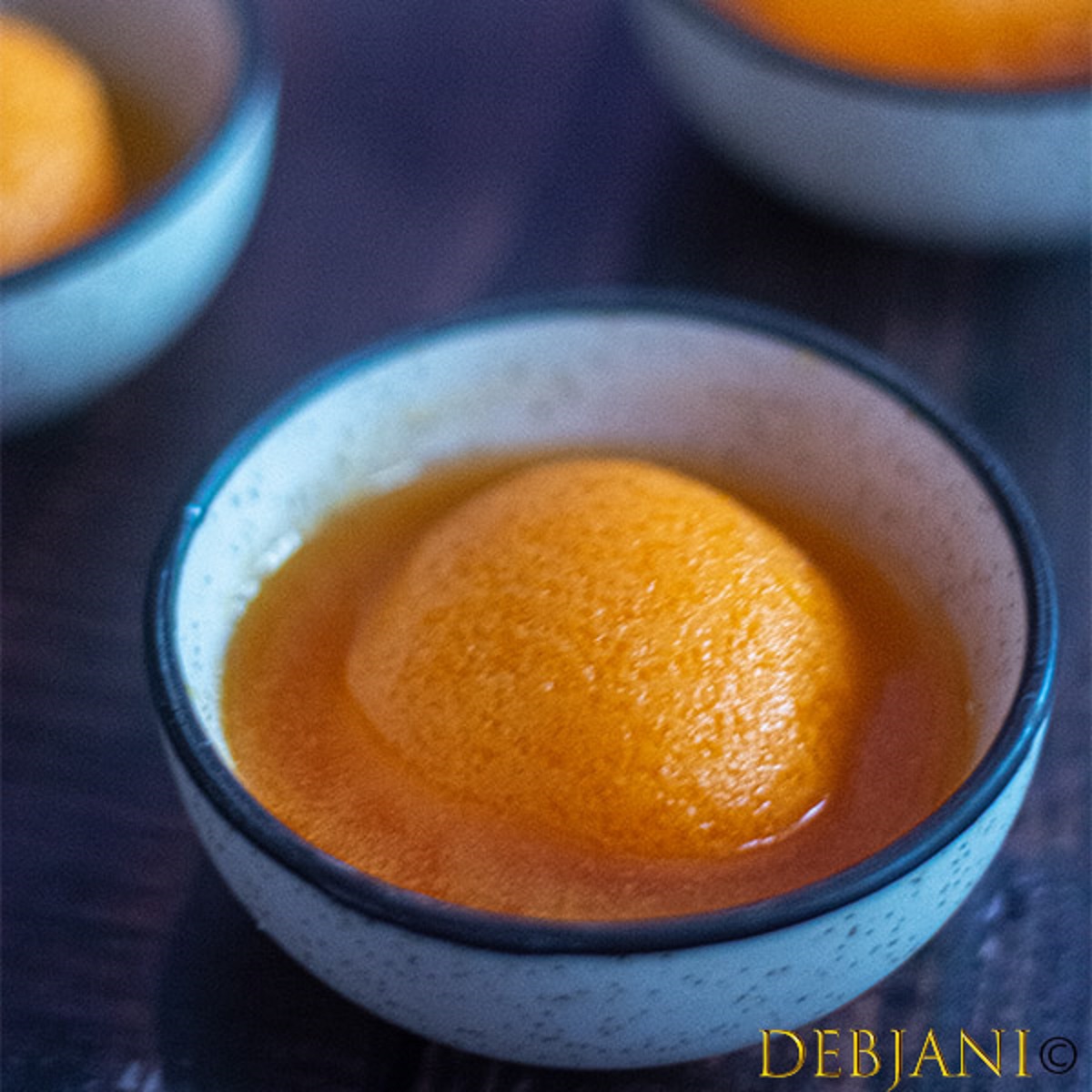
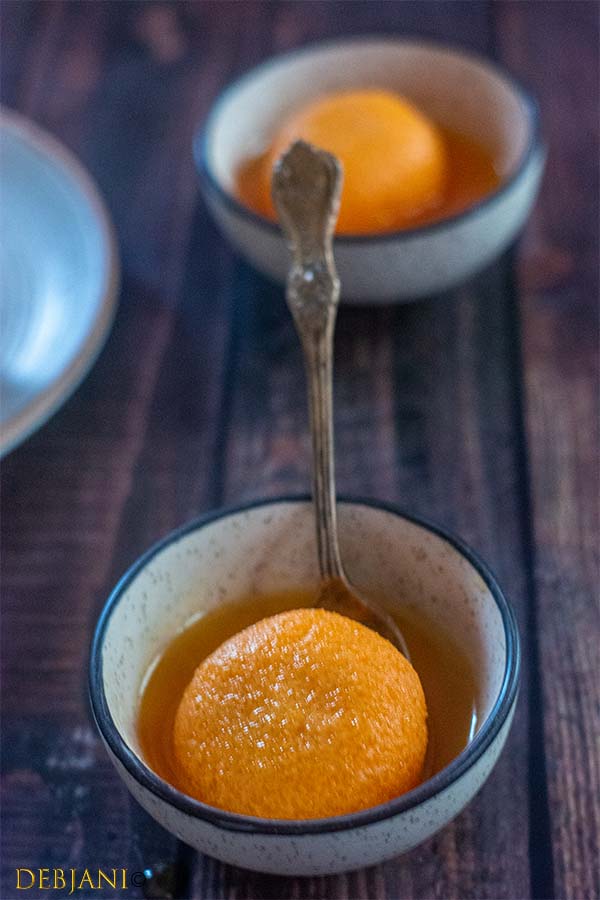
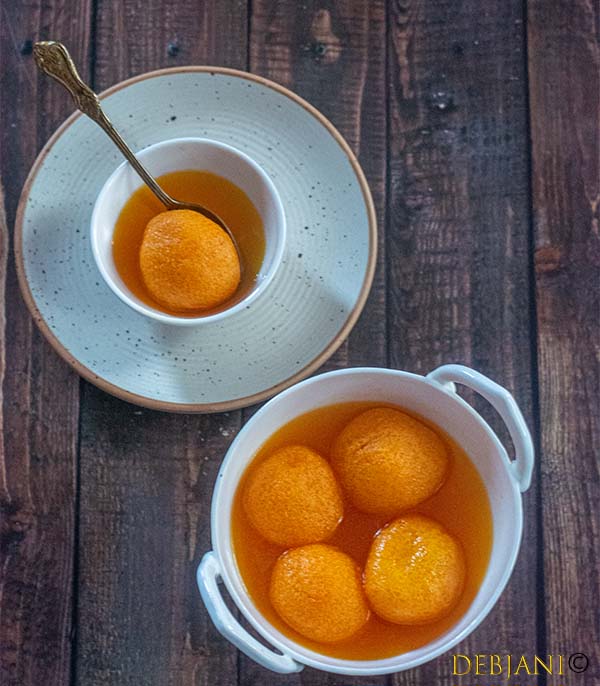
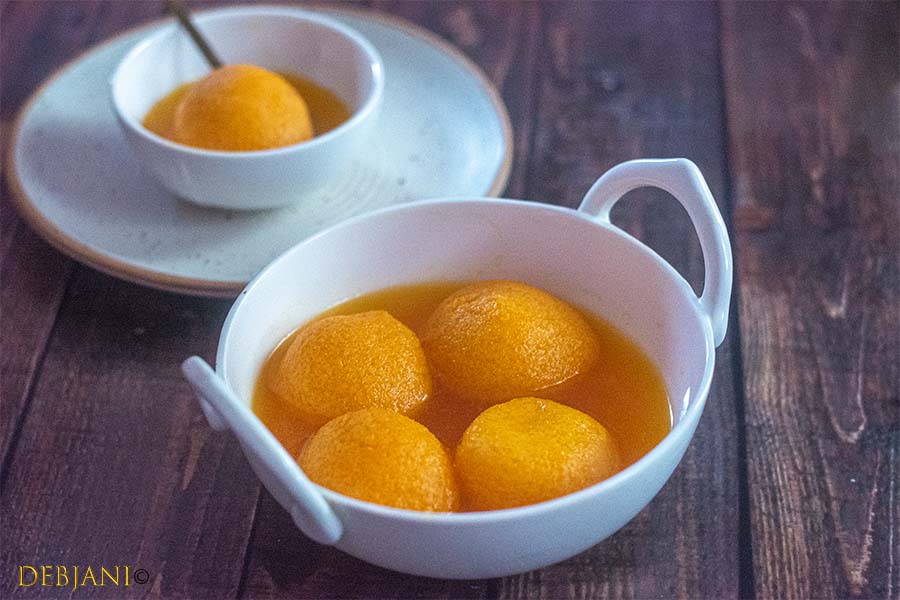
- Komolabhog!
- Here's how I make Kamala bhog at Debjanir Rannaghar!
- Recipe Card
- Bengali Sweets/ Desserts from Debjanir Rannaghar!
- Have you tried the Kamalabhog recipe from Debjanir Rannaghar!
- Here's the Kamala Bhog Pin for your Pinterest Board!
"What do you mean by you just made it like Roshogolla? You are talking about Kamalabhog, right? I hope you remember the difference! Dolon you have grown up seeing the haluikor making it at home and me even"
It was then I realized my mistake! I followed the recipe of my Gurer Roshogolla and tried to make Kamalabhog! We then talked for hours. Baba was talking about Thamma and her cooking skills. He was also remembering several occasions when we used to have "Vien" at home to make Mishti.
Biyebari, Haluikor Bamun, Vien, Mishti, etc before going further with Kamala Bhog!
Those who don't know, in the Bengali households, even a few years back, "Haluikor" aka the sweet makers were called during the occasions such as marriage to make desserts of a different kind. They used to come as a team. "Vien" was the common name for this system.
These days the system is almost obsolete. I don't see a team of cooks working at a marriage, living at the house, making sweets one by one following a chain! Their system was scientific and structured. They used to start with the making of Rosh aka Sheera or Suger Syrup. Three or four types of syrups were made starting with "ek tarer rosh" (single string); followed by "dui tarer rosh" (double string); "tin tar" (three strings) and "rongin rosh" (flavored and colored one). The last one was meant for Komola Bhog.
As I was saying their system was very structural back then, so I must share the details at least as much as I know. A meeting with the family to understand their need was a must. There were a few delicacies that were almost there in every marriage. Roshogolla, Rajbhog, Flavored Rajbhog (Mostly Kamalabhog); Chumchum, Bonde, Pantua, Kalojam, Sondesh, Makha Sondesh, Soktyo Pak Biye Sondesh Dorbesh, and Doi along with Kuncho Nimki, Padma Niumki were common. Once the syrup was ready, the next process was to make Chana and Kheer using the milk.
Difference between Roshogolla, Rajbhog, and Kamala Bhog!
The chana was then separated for each item. Roshogolla calls for Chana and light syrup while Rajbhog needs Semolina and stuffing along with the light syrup. Kamalabhog needed orange flavoring and also color along with the ingredients of Rajbhog!
....and then Sodesh, Bonde, Darbesh, Doi, Nimki & Khirmohon!
Sondesh or Makha Sondesh needed a portion of the heavy syrup however, most of the heavy syrup was needed to make Pantua, the more fried version of it Kalojam, Bonde, and also Darbesh. I must mention Chumchum is also prepared with heavier syrup. The spare flour from Bonde and Darbesh was used in making the Nimki. Doi was of three types; Tok doi, Mishti doi for the marriage feast, and Kheer doi for Totto. Then there was Biye Sondesh. The big fat korapaker Sondesh meant for the totto. I think I haven't missed anything. Though Baba is going to read this post and hopefully after criticizing me is going to help me with some more details. By the way, I forgot Khirmohon, the one which is in between Roshogolla and Chumchum and filled with Kheer.
Komolabhog!
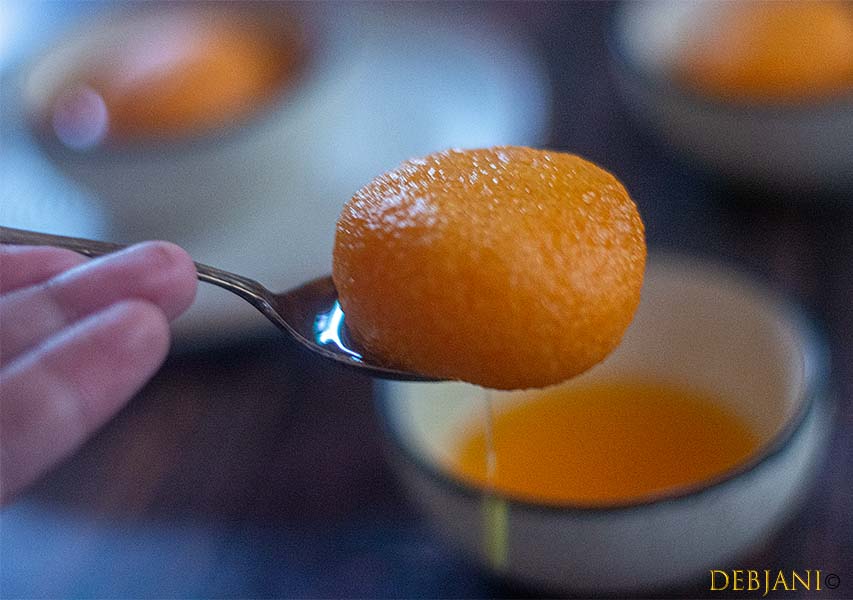
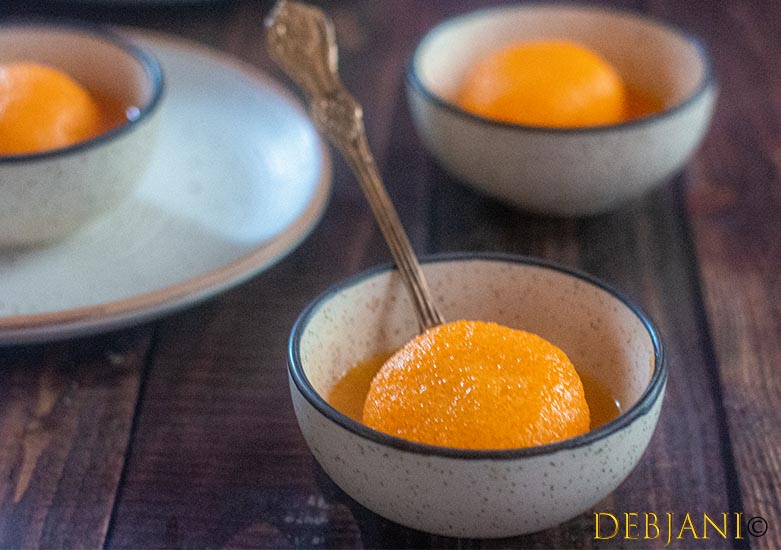
Now that I am done with the nostalgia-loaded details of Vien I must share about Kamalabhog. As I already have mentioned, Komolabhog is an orange-flavored Rajbhog. In this dessert, the cheese ball should not be spongy like Roshogolla. Ideally, it should be heavy and with a stuffing. The heaviness comes from Semolina aka Suji. Commercially original orange is not used in making the mishti, instead, orange essence and food color are used.
The trial and error at Debjanir Rannaghar!
I was initially trying to make the Komolabhog without adding semolina and also with orange instead of the essence and color. What I was getting was anything but Kamalabhog. Basically, I was following the recipe of Gurer Roshogolla! Baba told me to add suji and also to use essence and color and it worked. I must mention baba knows several intricacies about Bengali food and especially Mishti thanks to Thamma's influence. I have listed Baba's suggestions in the note section of the recipe. Though it took time, however, I really cannot complain about the recipe baba shared. In addition, the discussion was amazing for sure. It helped me a lot to draft this post. Though I know, I have written quite a lengthy one!
Here's how I make Kamala bhog at Debjanir Rannaghar!
Recipe Card
Kamala bhog aka Komolabhog
Kamalabhog is a signature Bengali orange flavored dessert which is a distant cousin of Roshogolla and first cousin of Rajbhog!
Ingredients
To make the Syrup:
- 300 g Sugar 2 Cups
- 2-3 drops Orange Essence
- A few drops Food color Orange
- 1 cup Orange Juice optional
- 1 teaspoon Orange Zest optional
- 10 strands Saffron
To make Komolabhog dough:
- 300 g Chana without moisture
- 4 tablespoon Semolina
- 2 tablespoon All-purpose Flour
- 2-3 drops Essence
- 3 drops Food color orange
- 10 strands Saffron
To make the stuffing:
- ¼ cup Khowa / dried milk
- ¼ teaspoon Powdered sugar
- 1 drop Orange essence

Instructions
Kamala Bhog recipe

- First, ensure the chana (chenna / paneer) is completely dry. You can do this by wrapping the chana or paneer in a cheesecloth, placing a weight on top, and leaving it for one hour.
- Next, use your fingers to mash the chana. Then, add all-purpose flour, semolina, saffron, food coloring, and flavoring, and knead until the mixture is smooth and lump-free. Divide this mixture into 20 equal portions and set them aside.
- While you're doing that, crumble the khoya and mix it with flavoring and powdered sugar. Form this mixture into 20 small balls.
- Now, take each chana ball and fill it with one of the khoya balls. Gently smooth each ball with your palm, making sure there are no cracks on the surface.
- In a deep pot, combine 4 cups of water and 1 cup of orange juice.
- Add the orange zest and bring the mixture to a boil.
- If you're not using orange juice, add an extra cup of water instead. Once it boils, turn off the heat and strain the liquid to remove the zest and any impurities.
- Return the liquid to the pot, add sugar, and boil until the sugar completely dissolves.
- Then, carefully add all the prepared balls into the pot at once.
- Increase the heat to high, cover the pot with a lid, and cook for 10 minutes without lifting the lid.
- Open the lid, and a cup of water.
- Keep the flame low and cook for 20 minutes.
- Now, add the saffron. Throughout the cooking process, add more water as needed to keep the syrup thin.
- It might take a little longer for the Kamalabhog to finish cooking.
- When it's done, the Kamalabhog will float on top of the syrup and turn a vibrant orange color. Turn off the heat and serve it at room temperature.

Notes
- Ensure your chana is dry. If you've made your own chana, press it for over an hour with a weight. This also applies to chana bought from a store. Measure the chana, not the milk.
- Include orange essence in both the dough and the syrup; this will prevent adding extra moisture from an orange. However, orange zest is essential.
- For every 100 grams of dry chana or paneer, use half a tablespoon of semolina.
- When preparing the syrup, you can add orange juice or a whole orange.
- If using orange juice, substitute it for an equal amount of water.
- Use orange food coloring in both the dough and the syrup.
Nutrition
Bengali Sweets/ Desserts from Debjanir Rannaghar!
- Chaler Payesh (Also known as Bengali Rice Kheer)
- Khejur Gurer Rosogolla (Also known as Nolen gurer rasgulla)
- Gujiya (Also known as Bengali Angti sondesh)
- Komola Kheer (Also known as Kheer Komola or Bengali Orange Kheer or Komlalebur Payesh)
- Darbesh (Also known as Bengali Laddu)
- Rosh Bora (Also known as Bengali Fritters served with Runny Sugar/ Jaggery syrup)
- Taler Bibikhana Pitha (Also known as Taler Pithe or Sugar Palm Cake)
- Choshir Payesh (Also known as chosi pithe)
- Patishapta (Also known as Bengali Patishapta Pitha)
- Manohora (Also known as Janaier monohora)
- Dudh Puli (Also known as Doodh pitha)
- Gurer Narkel Naru (Also known as Bengali Narkel Naru or Coconut Fudge Ball or Nariyel ki Laddu)
- Kancha Golla (Also known as Kanchagolla sondesh)
- Elo Jhelo (Also known as Bengali Elo Jhelo Nimki)
- Narkeli Jam Pitha (Also known as Bangladeshi jam pithe)
- Nolen Gurer Sandesh (Also known as Gurer norompaker Sondesh)
- Dimer Halwa (Also known as Egg Halwa or Ande Ka Halwa)
Have you tried the Kamalabhog recipe from Debjanir Rannaghar!
Do let me know how it came out. Also, I would love to see a picture of the same which you can share here at [email protected]. Meanwhile, on Instagram, you can use my hashtag #debjanirrannaghar and in addition, you can tag me at @foodofdebjani.
Here's the Kamala Bhog Pin for your Pinterest Board!

About Debjani Chatterjee Alam
I am Debjani Chatterjee Alam. A CSR specialist by profession and a food writer, food blogger, and food photographer as well. I live in Kolkata along with my Husband Mehebub who is an architect by profession, my daughter Pasta, and also my dog daughters Coffee and Luchi.

Debjani says
I think you decided to skip point number 2 intentionally! All-purpose flour is mentioned there. Secondly, I still go by the recipe which is tried and sampled. Quality of paneer/ chana varies and hence the note part. you must add 1/2 tbsp. per 100g. However you should have some ore available with you. So that if needed you can add a little to make perfect dough. I never believed in 1 Tsp. salt method; instead I prefer salt as needed. Hope this clarifies. Last but not the least, if you find the recipe unreliable; there are thousands of options available. I generally do that :).