

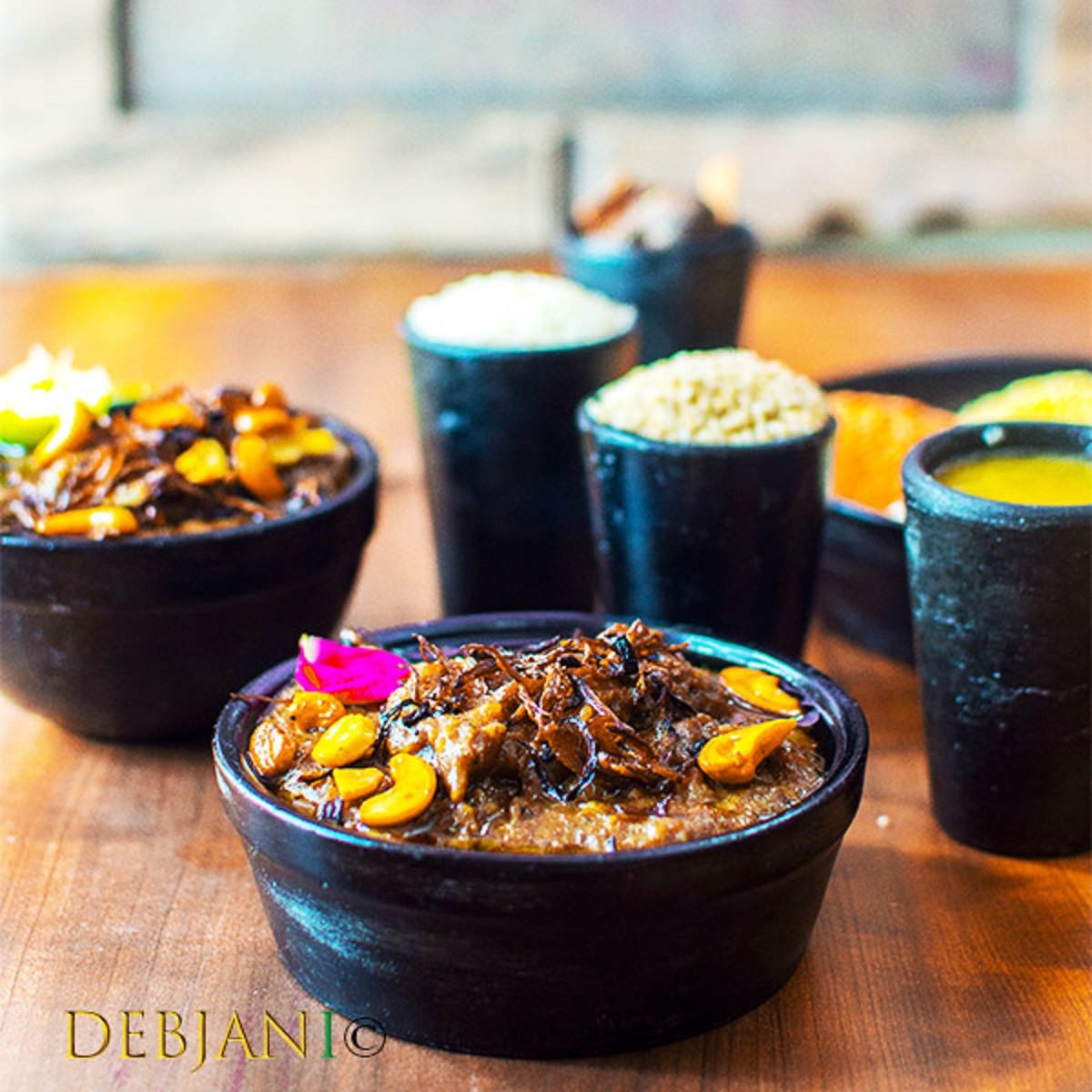
Haleem, a renowned Iftaar dish, is famous in both the Middle East and the Indian subcontinent. This rich street food, known for its thick texture and generous amount of ghee, is a staple in many markets. It's a hearty, soup-like dish made with meat, lentils, ghee, and various spices. Let's explore the recipe and details of the Hyderabadi version of Haleem.
Jump to:
- Debjani's Note
- Hyderabadi Haleem, A Ramadan Special delicacy
- History of Haleem
- Difference between Hyderabadi Haleem and Kolkata Haleem
- When I cook Haleem
- Recipe Tips
- Recipe Card
- Substitute and Add-ons
- Storage
- Ramadan Recipes
- Mutton Recipes
- Recipes that call for meat/ fish and lentils/ pulses together
- Have you tried the Hyderabadi Haleem Recipe from Debjanir Rannaghar?
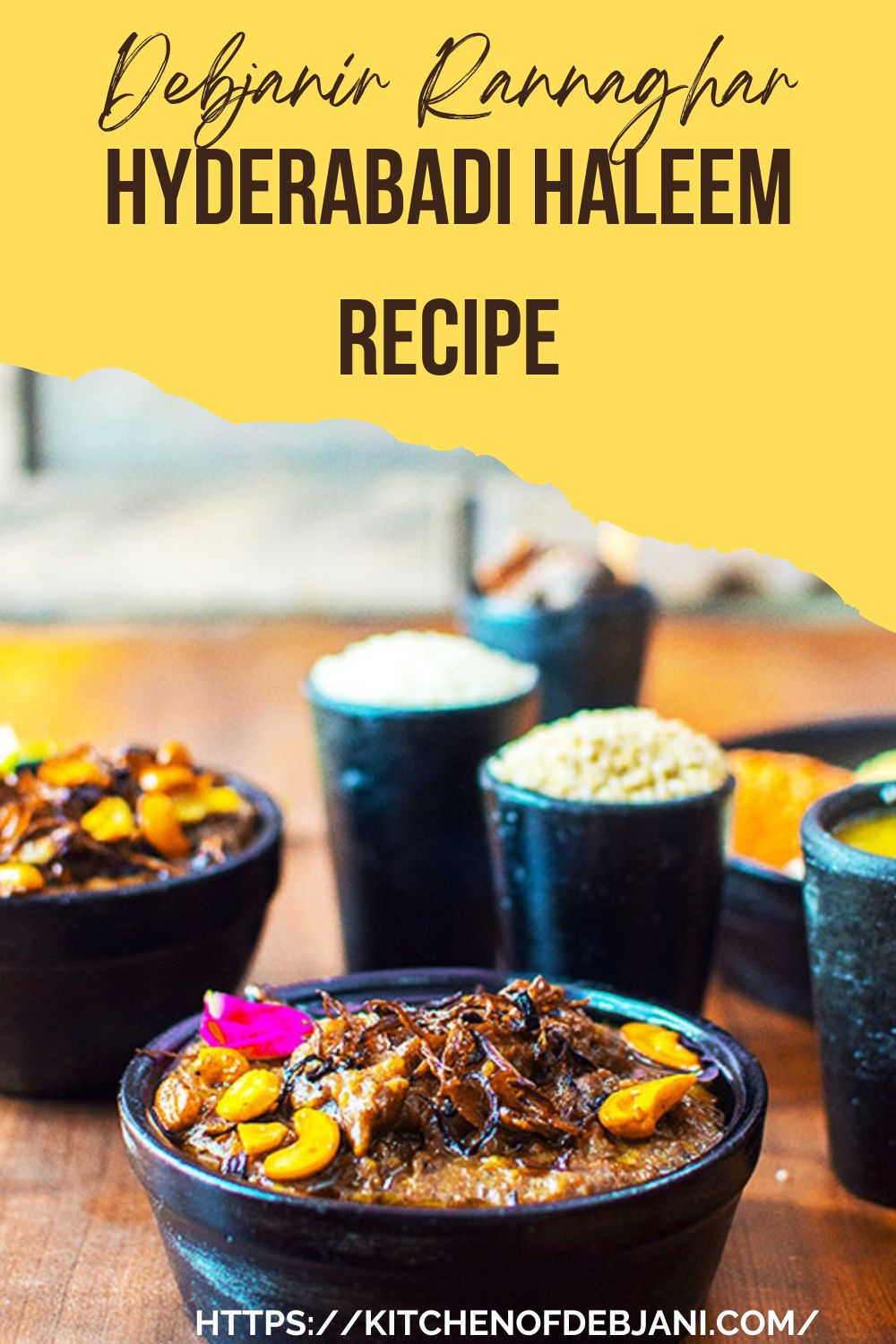
- Hyderabadi Haleem Pin for your Pinterest Board
Debjani's Note
I must admit, the Hyderabadi Haleem is the only version I prefer over the one from Kolkata when it comes to Mughlai food. I am all for Kolkata Biryani over Hederabadi biryani, but when it comes to Haleem, I prefer the Hederabadi version. Its rich, thick, smooth, and perfectly blended consistency truly sets it apart. I vividly recall my first taste of Haleem during Ramadan while at college in Kolkata. Muslim students were sharing it, and that's when I had my initial experience. However, the Kolkata version doesn't quite suit my taste. Anyone who has tried both Kolkata and Hyderabadi Haleem will surely understand the distinction.
It's worth noting that, according to Mehebub, Haleem has never been a regular dish at my in-laws' during Ramadan. In fact, they tend to eat light meals throughout the month, both for Sehri and Iftaar, unless they have guests over for Iftaar.
Her refrigerator serves as a communal collection point in the evenings. This is because she lives in a village in West Bengal where not everyone owns a fridge. Thanks to my marriage into a different faith, I've experienced wonderful aspects of both my Hindu upbringing and his Muslim culture.
Hyderabadi Haleem, A Ramadan Special delicacy
I first tasted Hyderabadi Haleem from Pishta House, a renowned establishment in Hyderabad known for this dish. Since 2013, when I was in Gurgaon, I've made it a tradition to order Haleem through Gati Konnect every year.
Haleem requires slow cooking, traditionally taking over eight hours to achieve the perfect texture. While I use a pressure cooker to speed things up, my version still cooks for about three hours. You can reduce the cooking time if you're in a hurry, but dedicating that extra time truly makes a difference.
History of Haleem
Haleem, a renowned Iftaar dish, originated in the Middle East and the Indian subcontinent. This thick, flavorful street food is famous for its mushy texture and generous amount of ghee. It's a soup-like dish, prepared with meat, lentils, ghee, and various spices. Haleem is incredibly popular in India, Pakistan, and Bangladesh. The dish evolved from the Arabian dish "Harees," which means "mash" and is made with meat and lentils. Harees itself is mentioned in a 10th-century cookbook called "Kitab Al Tabikh," and some even claim that Prophet Muhammad enjoyed Haleem.
Difference between Hyderabadi Haleem and Kolkata Haleem
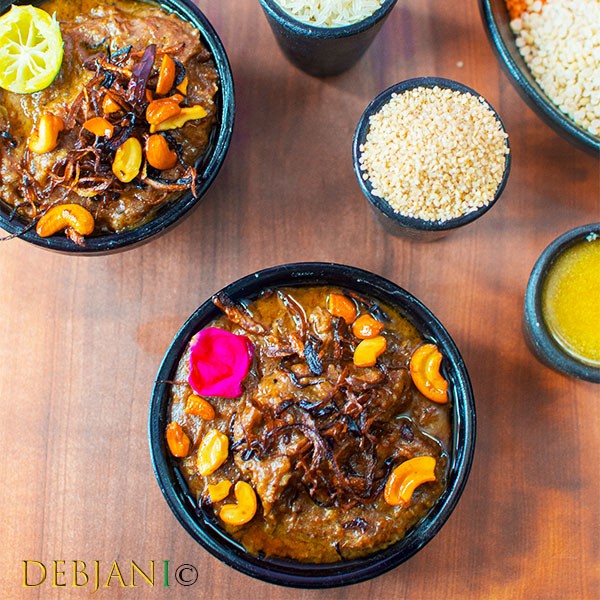
In India, both Hyderabad and Kolkata are famous for their unique versions of Haleem. Hyderabadi Haleem is a complete meal, featuring wheat, rice (or sometimes barley), lentils, and meat. It's known for being richer and thicker than Kolkata's Haleem. While Kolkata Haleem offers comforting flavors, Hyderabadi Haleem is considered a more opulent, royal dish. Haleem is a beloved dish among Muslims, especially for breaking their fast, but it's equally enjoyed by people from all backgrounds. After Biryani, Haleem is arguably the most popular and cherished Mughlai delicacy.
In Hyderabad, some of the best places for Haleem include Pista House, Hotel Shadab, Shah Ghouse Cafe & Restaurant, Charminar, and Paradise Food Court. For those in Kolkata, New Alia, Arsalan, and Shiraz are top choices. You can find more details about Kolkata's special Ramzan street food in another post I've written.

When I cook Haleem
My husband is Muslim, and while I am Hindu, we are both quite secular. We celebrate all religious holidays because we respect each other's beliefs and those of other faiths. During the month of Ramadan, I always make Haleem at home at least once or twice. I typically prepare Hyderabadi Haleem, usually the mutton version. It took me many years to perfect a recipe that truly rivals the Haleem found in Hyderabad.
Recipe Tips
This recipe uses a lot of ghee, along with lentils, wheat, and meat. You can certainly make a lighter version by skipping the ghee or using less, but I prefer not to! Haleem is a complete meal on its own. Muslim people often eat it in the evening after breaking their fast during Ramadan, when their bodies need good energy. With its combination of meat, lentils, wheat, and ghee, Haleem is a wonderfully balanced and nutritious dish.
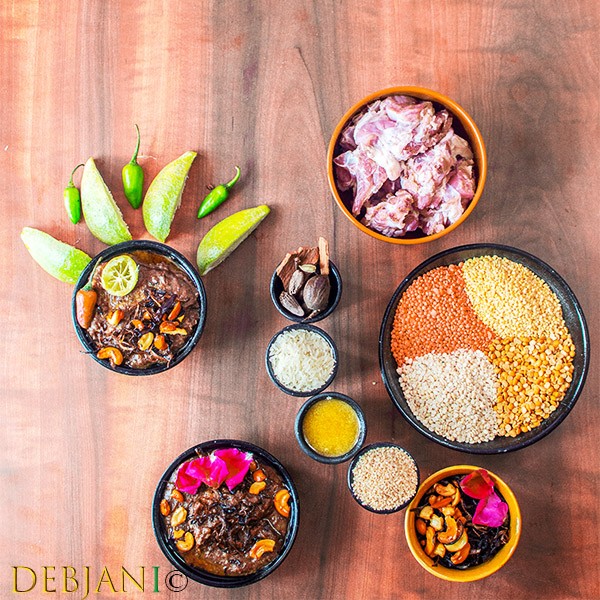
I use a blend of red lentils, yellow split lentils, pigeon peas, and skinless black gram. Keep in mind that people often use different kinds of lentils. Rice is an optional but very important ingredient, as it adds starch crucial for the dish's texture. Barley is also a common addition, but since I'm allergic to it, I don't include it. If you choose to use barley, simply reduce the amount of rice in the recipe by two tablespoons and replace it with barley. For a wonderful aroma, add dry roasted rose petals. You can easily substitute these with dried rose petals or a few drops of rose water.
Recipe Card
Hyderabadi Haleem| Mutton Haleem| Haleem Recipe
A famous Iftar delicacy, Haleem has its origin in the Middle East as well as in the Indian subcontinent. Hyderabadi Haleem is a wholesome meal prepared with Wheat, Rice (or at times Barley), lentils, and meat.
Equipment
- 1 heavy-bottom handi / deg
- 3 laddle
- 6-7 Bowls
- 1 Chopping Board
- 1 Knife
- 4-5 spoons
Ingredients
- 1.5 kg Mutton medium size pieces with bone
- 200 g Ghee
- 3 Onion
2 Tbsp. Garlic Paste:
- ⅕ tablespoon Ginger Paste
- 10-15 Green Chilli
- 5 tablespoon Lemon Juice
- 1.5 teaspoon Salt or to Taste
Pulses:
- 100 g Whole or Broken Wheat
- 50 g Yellow Split Lentil/ Moong Dal
- 50 g Red Lentil/ Masoor Dal
- 50 g Split Pigeon Peas/ Arhar Dal
- 50 g Black Gram without Skin/ Urad Dal/ Kolai Dal
- 50 g Rice
For Frying:
- 3 Onion
- 50 g Cashew Nut
- 100 ml Oil for deep-frying
Spices to make the Powder:
- 1 Cinnamon Stick
- 2 Black Cardamom
- 4 Green Cardamom
- 5 Clove
- 5 Kebab Chini
- ½ teaspoon Mace
- 10 Fresh Rose Petals
Spices for Tempering:
- 1 Cinnamon Stick
- 2 Black Cardamom
- 4 Green Cardamom
- 5 Clove
- 5 Kebab Chini
- ½ teaspoon Mace

Instructions
Cooking the Meat:

- Cut Onion into thin slices.
- Wash Mutton thoroughly.
- Take 1 tablespoon of Ghee in a pressure cooker and heat it properly.
- Temper the Ghee Cinnamon Stick, Black Cardamom, Green Cardamom, Clove, Kebab Chini, and Mace.
- Add sliced onion and fry till those turn translucent.
- Now add ginger and garlic paste and cook till oil leaves from the side of the mixture.
- Add Mutton chunks and mix thoroughly.
- Add ½ teaspoon of salt and slit Green Chilies.
- Now add 2 Cups of Hot water and cover the cooker with the lid with the weight on.
- Cook on a low flame until 7 whistles come out from the Pressure cooker.
- Open the Cooker once the pressure drops completely.
- Separate the bones from the mutton and mash the mutton slightly using a spatula.

Cooking the Pulses and Frying the Onion and Nuts:

- Cut the onion into thin slices.
- Heat the oil in a Pan and deep fry the onions, and keep aside. Use the same oil and fry the Cashew nuts till they turn brown in color.
- Dry roast the Rose petals and keep those aside.
- Take 1 teaspoon of ghee in a pan and heat it.
- Temper the Ghee with Cinnamon Stick, Black Cardamom, Green Cardamom, Clove, Kebab Chini, and Mace.
- Add all the pulses (Wheat, Rice, and lentils) until they emit a nutty aroma.
- Switch off the flame and leave the pulses until completely cooled down.
- Take the mixture along with roasted rose petals and ⅓ of the fried onion and⅓ of the fried Cashew nut and grind into a coarse mixture.
- Take the mixture along with 8 Cups of water and ½ teaspoon of salt in a pressure cooker and cook on low flame with the weight on for 20 minutes.
- Switch the flame off and wait till the pressure drops to open the Cooker.

Finishing Haleem:

- Now transfer the mashed mutton to the cooker containing the Lentil mixture and cook on a low flame for 2 hours.
- You may add a little water in between.
- Adjust the salt if required.
- Stir in every 10 minutes.
- Once done, add the rest of the Ghee and cook for 5 more minutes.
- Top Hyderabadi Haleem with Fried Onion, Fried Cashew Nuts, and Lemon Juice, and serve hot.

Notes
Substitute and Add-ons
- Rice is an optional, however, a very important ingredient. It provides starch to the dish
- If using barley, reduce 2 Tbsp. of rice and substitute it with Barley.
- I have used broken wheat instead of whole wheat.
- The more the slow cooking, the more the chance of getting the desired texture.
- You may increase or decrease the portion of pulses; however, the ratio I have given provides perfect texture.
- Increase or decrease Green Chillies as per taste.
- You may decrease the amount of Ghee or substitute it with Oil. However, Ghee is required not only for the flavor but for the texture as well.
- Instead of roasting fresh rose petals, you may use dried rose petals available in the market.
- Don't add Lemon juice while cooking. It is better to top the Haleem with lemon juice and crisp onion & fried Cashew nuts at the time of serving it.
- Some people prefer to have Haleem with Mint leaves as well. However, I don't like to top my Haleem with mint leaves.
Storage
- You may store Haleem in the refrigerator for more than 7 days. In fact, Leftover Haleem tastes heavenly!
Nutrition
Ramadan Recipes
Looking for other recipes like this? Try these:
- Kolkata Mutton Biryani | Calcutta Biryani
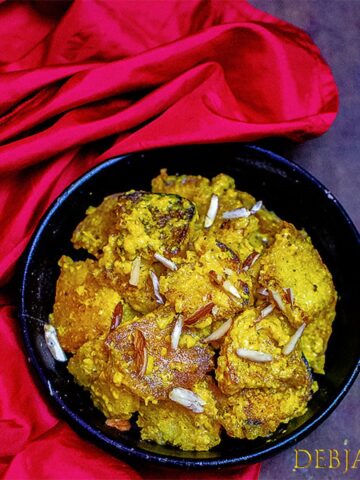
- Dimer Halwa (Egg Halwa or Ande Ka Halwa)
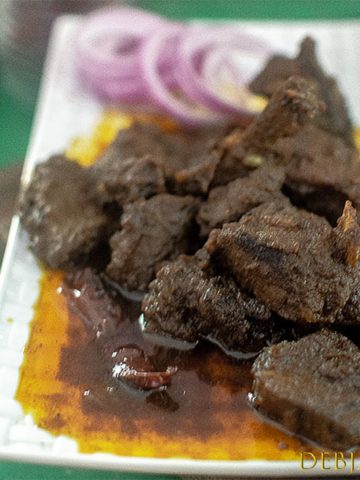
- Bangladeshi Kala Bhuna | Beef Kala Bhuna | Kalo Bhuna Recipe
- Chicken Keema Pakoda | Chicken Mince Fritters
- Dhakai Morog Pulao | Sahi Morog Pulao
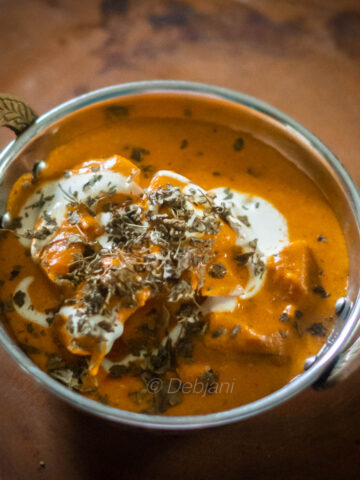
- Restaurant-style Butter Chicken | Murgh Makhani | Chicken Makhani
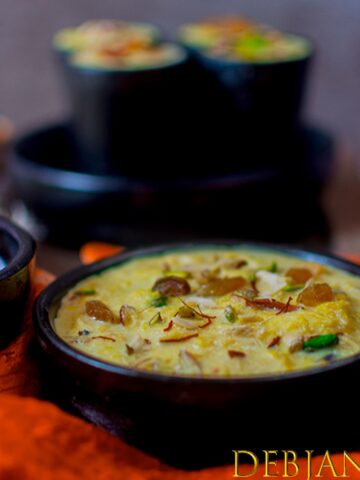
- Sheer Khurma
- Hyderabadi Double ka Meetha



Mutton Recipes
Recipes that call for meat/ fish and lentils/ pulses together
- Mutton Dhansak
- Macher Matha diye Bhaja Muger Dal aka Moong Dal with Fish head
- Muri Ghonto aka Bengali Fish head and rice Hotchpotch
- Indian Rice and Chicken Hotchpotch
Have you tried the Hyderabadi Haleem Recipe from Debjanir Rannaghar?
Do let me know how it came out. Also, I would love to see a picture of the same which you can share here on [email protected] or on Instagram you can use my hashtag #debjanirrannaghar or can tag me at @foodofdebjani.
You can follow me on Facebook, Twitter, Pinterest, and Instagram for updates and recipes from Debjanir Rannaghar.
Hyderabadi Haleem Pin for your Pinterest Board

About Debjani Chatterjee Alam
I am Debjani Chatterjee Alam. A CSR specialist by profession and a food writer, food blogger, and food photographer as well. I live in Kolkata along with my Husband Mehebub who is an architect by profession, my daughter Pasta, and also my dog daughters Coffee and Luchi.


Ranjita Patnaik says
Devjani… Your mutton haleem is truly exceptional—flavorful, perfectly spiced, and cooked with perfection. What makes it even more impressive is how you breaks down the recipe into clear, simple steps that anyone can follow with ease. Your engaging writing style and attention to detail make the cooking process enjoyable and accessible, ensuring your viewers feel confident throughout. Your passion shines through every aspect of your blog, turning a complex traditional dish into a delightful culinary experience for all. Your mutton haleem is a delicious masterpiece that deserves high praise!
Debjani says
Dear Ranjita,
First of all, I am extremely sorry for replying late. Also, thank you so much for your kind words.