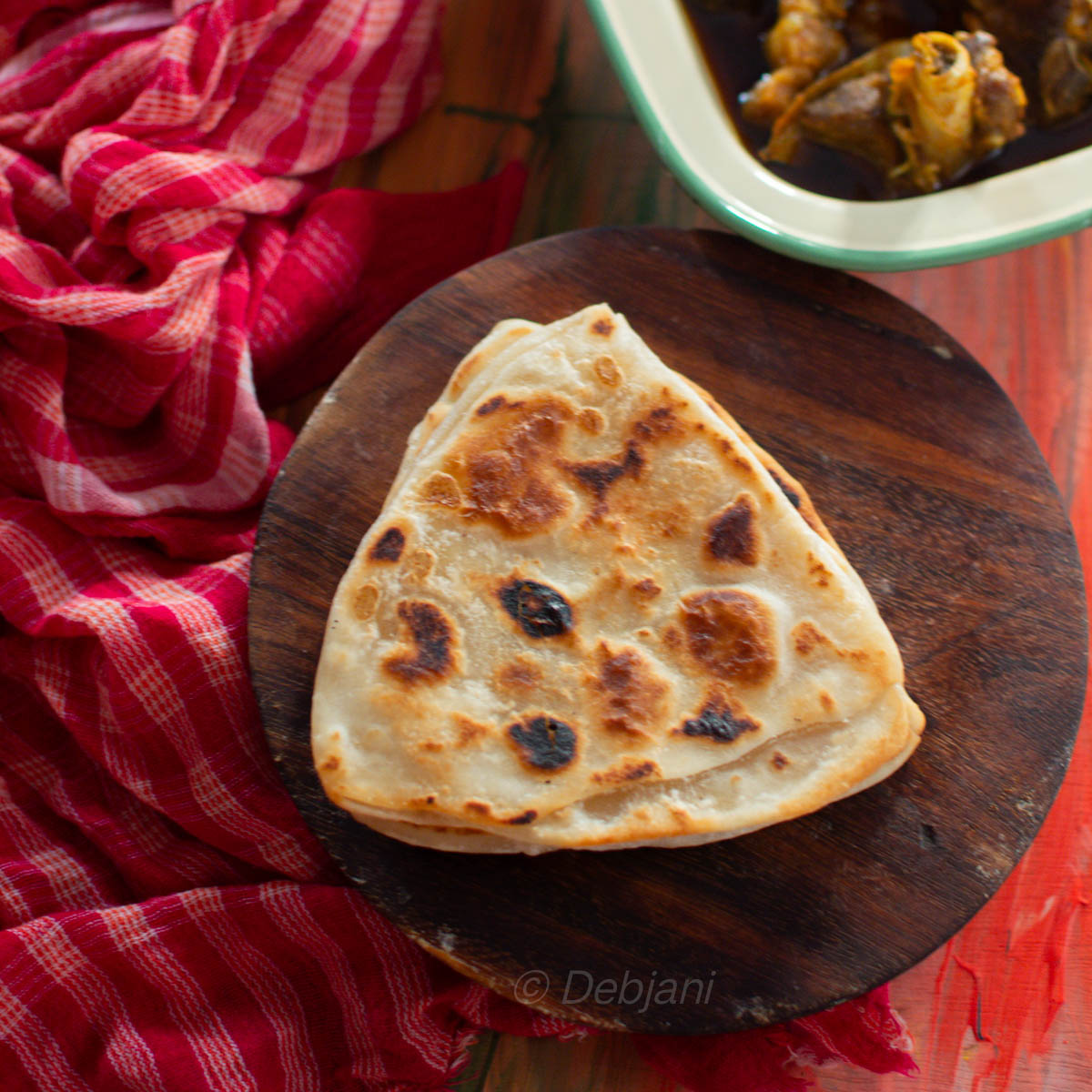
Tinkona Porota Recipe | Bengali Triangular Paratha
Tinkona Porota is a signature Bengali triangular flatbread, traditionally crafted from all-purpose flour, known to Bengalis as Maida. Unlike typical Indian parathas made with whole wheat, this is a distinct andcherished dish. Let's explore how to prepare this ideal Bengali porota, resultingin a delightfully crispy, soft, and beautifully layered treat.
Print
Pin
Servings: 3 people
Calories: 718kcal
Cost: Rs 50
Ingredients
To make the dough
- 250 g All-purpose flour / Maida
- ½ teaspoon salt
- ½ teaspoon sugar optional
- 2 tablespoon refined oil can be substituted with ghee
- ⅔ cup water warm
to roll the paratha
- 1 tablespoon refined oil
To shallow-fry tinkona porota
- 7 tablespoon refined oil can be substituted with ghee

Instructions
- Take 250 grams of all-purpose flour in a bowl. I prefer to sift it to ensure it's free from impurities.
- Next, add half a teaspoon of salt and half a teaspoon of sugar to the flour. Sugar is optional.
- Then, incorporate three tablespoons of refined oil; ghee can be used instead.
- Mix everything together until the mixture resembles coarse crumbs.
- Have two-thirds of a cup of warm water ready for the dough. Begin kneading the dough with half a cup of water, adding a little more if necessary. The key is to knead the flour to develop its gluten. The dough should not be sticky, but rather have some elasticity.
- Knead for at least five minutes to achieve the desired texture. This improves with practice, but remember to avoid a runny or overly sticky dough.
- Once the dough is ready, cover it with a damp cloth and letit rest at room temperature for ten minutes before making the flatbread / paratha.
- Keep some refined oil nearby for when you're making the tinkona porota.
- You will also need a rolling pin and board (Chaki Belun).
- First, divide the dough into 6-7 equal portions; 250 grams of flour will yield about 6-7 Porotas.
- Now, shape each portion into a ball.
- Place the dough on the kitchen counter/ board/ chaki to flatten and shape the paratha. Do not use raw flour for shaping, unlike North Indian parathas. Instead, rub a little oil on both sides of the dough ball and gently press to flatten it.
- Now, use a rolling pin to shape the dough ball into a round roti. Apply oil on the top side.
- Fold the roti in half to create a D-shape. Lightly roll it out with the rolling pin to make this D-shape larger.
- Apply oil again to the top and fold it to form a perfect triangle. Also, apply oil to the other side.
- Oiling each layer will help make the paratha crispy.
- Now, roll it out one last time, and your triangular paratha is shaped and ready.
- Meanwhile, heat a griddle/ tawa over medium heat. Place the paratha on the griddle and cook on low heat for about a minute.
- Then, flip it to shallow-fry the other side.
- Add about half a tablespoon of refined oil to the paratha, spread it around, and fry for another minute.
- Flip it again, add another half tablespoon of oil to the other side, and shallow-fry until the paratha is cooked, not burnt.
- It's best to fry one porota at a time, especially if you're trying to use less oil.
- Continue this method for the rest of your porotas.
- Finally, enjoy your Bengali porotas with your favorite side dishes.
Notes
Substitution & Variations
- For a richer paratha, you can use ghee instead of oil throughout the recipe.
- While this recipe specifically calls for all-purpose flour to maintain its authentic Bengali character, you do have the option to use whole-wheat flour if you prefer.
- Although optional, adding sugar enhances the paratha's flavor.
- Some individuals also knead the dough with milk or yogurt instead of water to achieve a softer texture.
Nutrition
Calories: 718kcal | Carbohydrates: 64g | Protein: 9g | Fat: 47g | Saturated Fat: 2g | Cholesterol: 0mg | Sodium: 196mg | Potassium: 45mg | Fiber: 1g | Iron: 2mg
